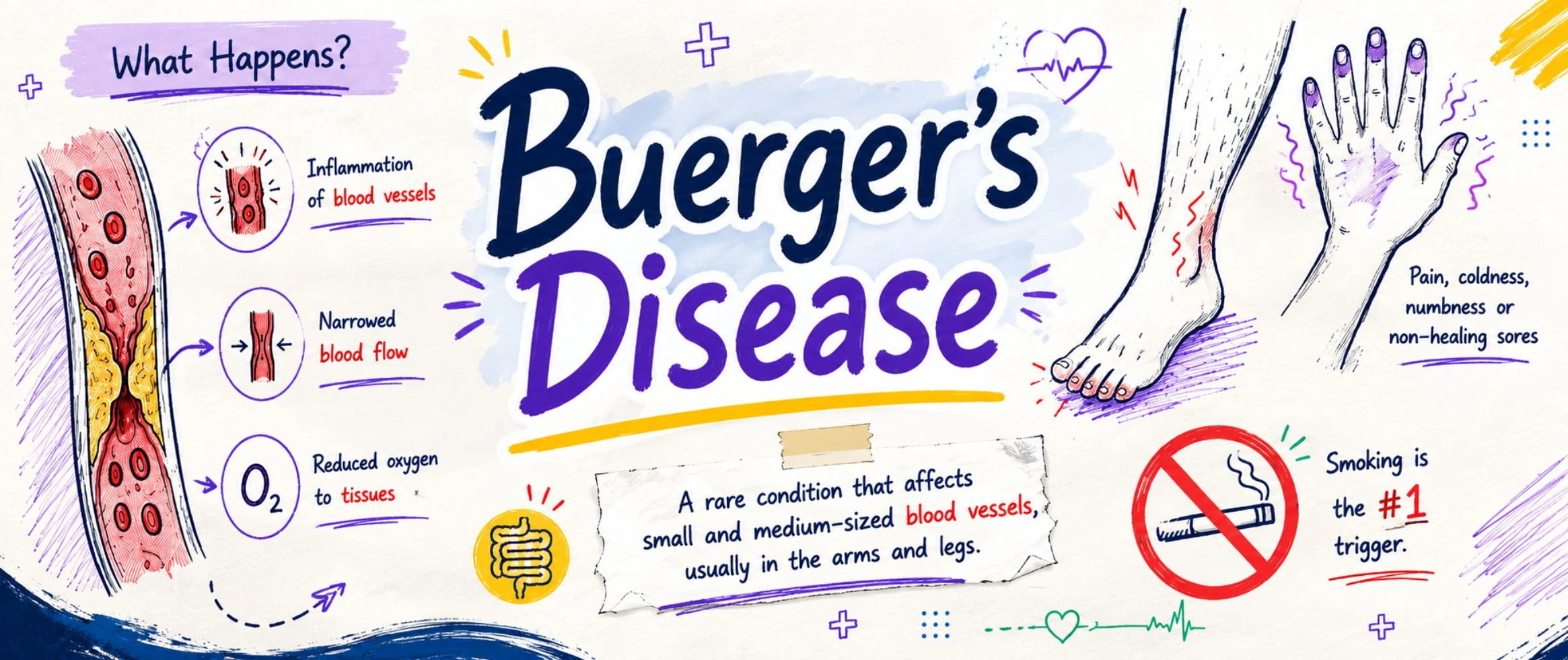
Buerger’s disease is a rare condition that affects the small and medium-sized blood vessels in the arms, hands, legs and feet. It causes inflammation and swelling inside the vessels. Blood clots may then form, making it difficult for blood to reach the fingers and toes.
The medical name for Buerger’s disease is thromboangiitis obliterans. Some people also search for it as Buerger’s syndrome or “Bergers syndrome,” but the standard medical spelling is Buerger’s disease.
When blood flow is reduced for a long time, the skin and tissues may not receive enough oxygen. This can lead to pain, ulcers, infection and, in severe cases, gangrene or amputation. Buerger’s disease is strongly linked to tobacco use, including smoking and chewing tobacco. Completely stopping tobacco is the most important step in managing the condition.
The exact cause of Buerger’s disease is not fully understood. However, tobacco exposure is the strongest known risk factor. Chemicals in tobacco may irritate the blood vessel lining and trigger inflammation and clot formation.
Tobacco products linked with Buerger’s disease may include:
Not every tobacco user develops Buerger’s disease, and researchers are still studying why some people are more vulnerable. Genetic factors and an abnormal immune response may also contribute.
The condition is more commonly seen in younger adults, particularly those who use tobacco. However, it can affect people of different ages and genders. A person should not assume that limb pain is Buerger’s disease simply because they smoke. Other conditions, such as diabetes, atherosclerosis, nerve disorders, blood clots and autoimmune diseases, can cause similar symptoms.
Buerger’s symptoms often begin in the fingers, toes, hands or feet. They may develop gradually and can become worse if tobacco use continues.
Common symptoms include:
1. Pain in the Hands, Feet, Arms or Legs
Pain may occur while walking or using the affected limb. As the disease progresses, pain can also occur at rest. Some people describe it as burning, cramping, throbbing or aching.
Leg pain that appears during walking and improves after resting is known as claudication. It happens because the muscles are not receiving enough oxygen during activity.
2. Numbness, Tingling or Burning
Reduced blood flow may cause pins-and-needles sensations, numbness or burning in the fingers and toes. These symptoms may be mistaken for a nerve problem, especially in the early stages.
3. Cold Fingers and Toes
The affected hand or foot may feel colder than the other side. Cold weather can make the symptoms more noticeable because blood vessels naturally narrow in response to cold.
4. Changes in Skin Colour
The fingers or toes may become pale, bluish, purple or reddish. Colour changes may worsen after exposure to cold or tobacco smoke.
5. Skin Sores and Non-Healing Ulcers
Small cuts, blisters or wounds on the toes and fingers may heal slowly. A minor injury can become serious when blood circulation is poor.
6. Swelling and Pain Along a Vein
Some patients may develop inflammation or clotting in a superficial vein. This can cause a tender, red or cord-like area under the skin.
7. Gangrene
In advanced cases, severely reduced blood flow may cause tissue death. The affected skin may turn black or blue, lose sensation or develop an unpleasant odour. Gangrene requires urgent medical attention. Cleveland Clinic
Do not ignore persistent pain, colour changes or wounds on the fingers and toes, particularly if you use tobacco.
Seek urgent medical care if you notice:
These signs may indicate severe loss of blood flow, infection or tissue damage.
There is no single blood test that confirms Buerger’s disease. Diagnosis usually involves a detailed medical history, physical examination, blood vessel tests and investigations to rule out other diseases.
The doctor may ask about:
During the examination, the doctor may check the pulses, temperature, skin colour, sensation and wounds in the affected limb.
People often search for a specific “Buerger’s test.” However, there is no single test that diagnoses the disease. Instead, doctors may use several investigations.
Ankle-Brachial Index
The ankle-brachial index, or ABI, compares blood pressure in the ankle with blood pressure in the arm. It helps identify reduced blood flow to the legs.
Doppler Ultrasound
A Doppler ultrasound uses sound waves to assess blood flow through the arteries and veins. It is non-invasive and may help locate narrowed or blocked vessels.
Plethysmography
This test measures changes in blood volume in the arms or legs. It may be useful when blood flow to the fingers or toes needs closer assessment.
CT Angiography or MR Angiography
These imaging tests create detailed pictures of blood vessels. They may help identify the location and pattern of blockages.
Conventional Angiography
In some cases, a catheter-based angiogram is performed. A contrast dye is introduced into the blood vessels, followed by X-ray imaging. It may show small, twisted collateral vessels sometimes described as “corkscrew” vessels. However, these findings are not unique to Buerger’s disease and must be interpreted with the patient’s history and examination.
Blood Tests
Blood tests do not confirm Buerger’s disease. They are usually performed to exclude other causes of reduced circulation or blood vessel inflammation.
Depending on the clinical situation, the doctor may recommend tests such as:
A diagnostic laboratory such as Pathkind Labs can support physician-directed blood testing. However, laboratory reports alone cannot diagnose Buerger’s disease. The final assessment usually requires a vascular specialist and appropriate imaging.
An echocardiogram may also be recommended if the doctor wants to look for a possible source of blood clots. A blood vessel biopsy is rarely required and is generally considered only when the diagnosis remains unclear.
There is currently no permanent cure for Buerger’s disease. The main aim of Buerger’s treatment is to stop the disease from progressing, improve blood flow, control pain and prevent infection or tissue loss.
1. Stop All Tobacco and Nicotine Use
Complete tobacco cessation is the most important treatment. Even a small amount of continued tobacco exposure may allow the disease to progress.
Quitting may be difficult, especially for people who have used tobacco for many years. A doctor, tobacco-cessation counsellor or addiction specialist can help create a plan. Support may include counselling, behavioral therapy and non-nicotine medicines where appropriate.
People with Buerger’s disease should discuss nicotine replacement products with their doctor before using them. Nicotine may affect blood vessels, and the best quitting approach can differ from person to person.
2. Medicines
A doctor may prescribe medicines based on symptoms and the severity of blood-flow restriction. These may include:
Medicines should not be started without medical advice. They cannot replace complete tobacco cessation.
3. Wound Care
Ulcers and wounds need careful treatment. The doctor may recommend cleaning the wound, applying dressings and treating infection. Avoid applying strong chemicals, home remedies or heating devices to numb fingers or toes, as burns may occur without being noticed.
4. Physical Activity
Gentle, supervised activity may help maintain circulation and muscle function. However, exercise should be guided by a doctor when there is severe pain, an ulcer or critical limb ischemia.
5. Procedures and Surgery
In selected cases, doctors may consider procedures to improve blood flow. These can include angioplasty, bypass surgery or other vascular procedures. Because Buerger’s disease often affects small and distal blood vessels, surgery may not be suitable for everyone.
If tissue has died or a serious infection has developed, removal of the affected toe, finger or limb may be necessary. Early treatment and complete tobacco cessation can reduce the risk of reaching this stage.
There is no guaranteed way to prevent every case because the exact cause is not known. However, avoiding tobacco is the most effective preventive measure.
Helpful steps include:
People with diabetes or other circulation problems should be especially careful about foot care. A small injury can become difficult to heal when blood supply is reduced.
Buerger’s disease may cause Raynaud-like colour changes in the fingers or toes. Raynaud’s phenomenon occurs when blood vessels temporarily narrow in response to cold or stress.
The two conditions are not the same. Raynaud’s symptoms often improve after warming the hands or feet, while Buerger’s disease may cause ongoing pain, ulcers, reduced pulses and tissue damage. A doctor can help identify the cause of repeated colour changes.
Buerger’s disease is a serious blood vessel condition closely linked to tobacco use. Its symptoms may begin with cold fingers, colour changes, tingling or pain, but they can progress to ulcers, infection and gangrene.
There is no single Buerger’s test. Diagnosis usually involves a physical examination, vascular imaging and tests to exclude other conditions. The most important part of Buerger’s treatment is complete and permanent cessation of tobacco and nicotine exposure. If you notice persistent limb pain, non-healing wounds or unusual colour changes, consult a doctor promptly.
Medical disclaimer: This article is for general education and does not replace consultation, diagnosis or treatment from a qualified healthcare professional.
Discover precision diagnostics with Pathkind Labs, a trusted name in diagnostic services in India. Our NABL accredited labs, equipped with advanced technology, are staffed by a certified team of over 200+ senior pathologists and 2000+ technicians. From tailored health check-ups to specialized tests in Oncology, Neurology, Gynaecology, Nephrology, and more, we've got your health covered. Skip the hassle with online booking for tests or check-ups, available for both lab visits and at-home blood collection. For a seamless experience and early detection, choose Pathkind Labs in Gurugram. Book your appointment today and experience diagnostics made easy.
© 2026 Pathkind Diagnostics Pvt. Ltd. All Rights Reserved | Unsubscribe










 Track Sample
 Upload Prescription