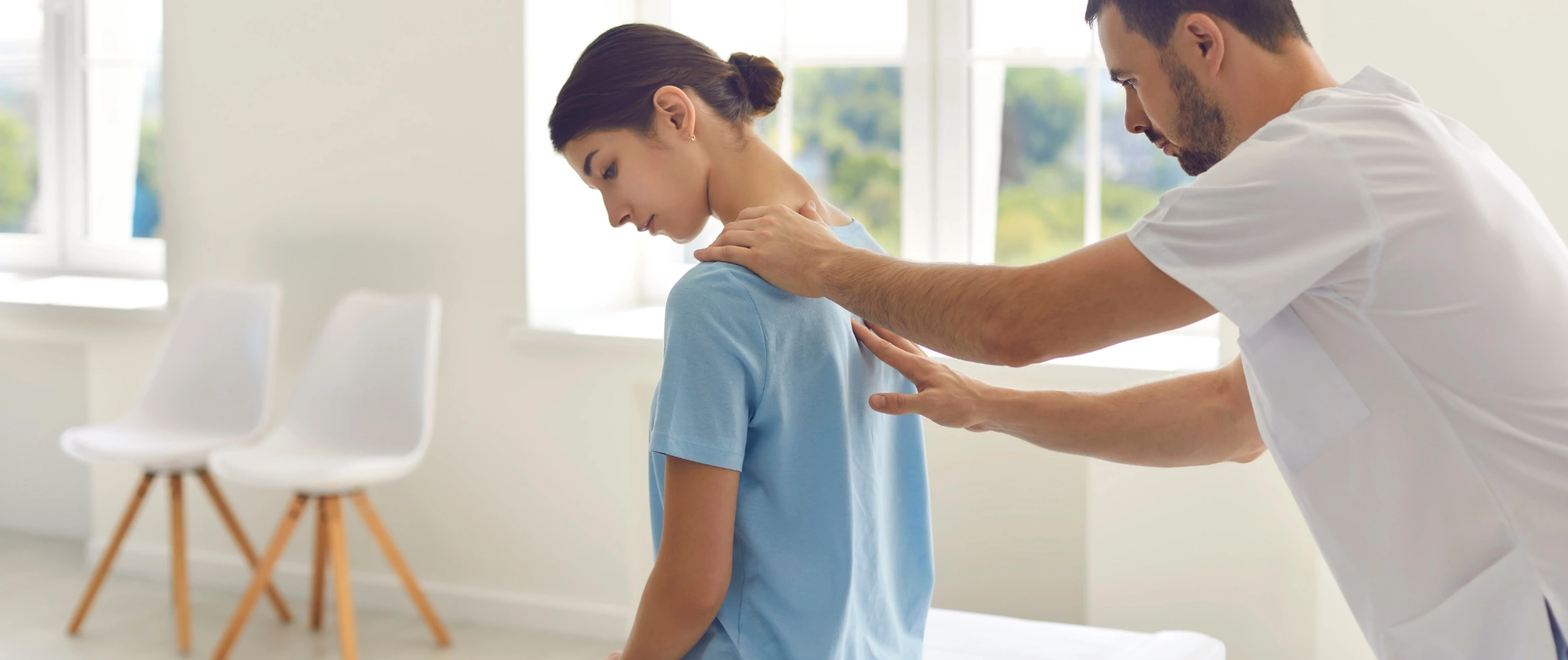
Have you ever noticed someone standing with one shoulder higher than the other? Or maybe a child’s school uniform looks uneven even when it fits properly? Sometimes, these small body changes are not just posture issues. They may be early signs of scoliosis.
Scoliosis is a condition where the spine bends sideways, often forming an “S” or “C” shape when seen from the back. It is commonly found in children and teenagers, especially during growth spurts, but adults can also develop it. In many cases, scoliosis is mild and does not cause serious problems. But in some people, the curve may increase over time and affect posture, movement, pain levels, and rarely, breathing.
In this blog, let’s understand what is scoliosis, the main types of scoliosis, common scoliosis causes, symptoms, diagnosis, and available scoliosis treatment options in simple language.
Scoliosis is an abnormal sideways curve of the spine. A healthy spine has natural curves when seen from the side, but it usually looks straight when seen from behind. In scoliosis, the spine bends to the left or right and may also rotate slightly.
According to NIAMS, scoliosis may appear as a C-shaped or S-shaped curve and can happen in different parts of the spine. Most cases in children and teens are idiopathic, meaning the exact cause is not known.
Scoliosis is most commonly diagnosed during late childhood or early teenage years when the body is growing quickly. Girls are more likely than boys to develop curves that may need treatment.
Scoliosis symptoms can be very mild in the beginning. Many parents notice it when a child bends forward, wears fitted clothes, or stands in front of a mirror.
Common signs include:
NIAMS notes that severe curves may lead to back pain and, rarely, breathing problems if the curve affects the chest area.
Understanding the types of scoliosis helps doctors decide the right care plan. Each type affects the spine differently.
Idiopathic scoliosis is the most common type. “Idiopathic” means the exact cause is unknown. AAOS explains that this is by far the most common type of scoliosis and usually appears from age 10 until a child is fully grown.
How It Affects the Spine
In idiopathic scoliosis, the spine slowly bends sideways during growth. The curve may be mild and stable, or it may worsen during a growth spurt.
It is often divided into:
Infantile Idiopathic Scoliosis
This appears in children below 3 years of age. It is rare. Some cases improve naturally, while others need careful monitoring.
Juvenile Idiopathic Scoliosis
This appears between ages 4 and 10. Since the child still has many years of growth left, doctors usually monitor it closely.
Adolescent Idiopathic Scoliosis
This is the most common form and appears between ages 10 and 18. It may become noticeable during puberty when height increases quickly.
Congenital scoliosis is present at birth. It happens when the bones of the spine do not form properly before birth.
How It Affects the Spine
In this type, one or more spinal bones may be misshaped, fused, or incomplete. Because the spine grows unevenly, the curve may increase as the child grows.
Parents may notice uneven shoulders, a tilted trunk, or a visible curve early in childhood. Treatment depends on the severity and speed of progression.
3. Neuromuscular Scoliosis
Neuromuscular scoliosis develops because of conditions that affect the nerves or muscles. These may include cerebral palsy, muscular dystrophy, spinal muscular atrophy, or spinal cord injury.
How It Affects the Spine
When muscles cannot support the spine properly, the spine may bend to one side. This type can progress faster than idiopathic scoliosis and may cause sitting imbalance, posture problems, and difficulty with daily movement.
In severe cases, it may affect chest shape and breathing.
Degenerative scoliosis usually affects adults. It develops due to age-related changes in the spine, such as disc wear, arthritis, weak bones, or spinal joint changes.
How It Affects the Spine
As the discs and joints of the spine weaken, the spine may start bending sideways. This type often affects the lower back and may cause:
Cleveland Clinic notes that adult scoliosis may cause pain, movement issues, height loss, uneven pelvis or hip alignment, and changes in appearance.
Functional scoliosis happens when the spine appears curved due to a problem outside the spine. For example, one leg may be shorter than the other, or muscle spasms may pull the body to one side.
How It Affects the Spine
The spine itself is usually normal. Once the underlying problem is treated, the curve may reduce or disappear.
The exact scoliosis causes depend on the type. In many children and teenagers, the cause is not known.
Common causes and risk factors include:
Mayo Clinic states that the cause of most childhood scoliosis is unknown, though the condition often appears during the growth spurt after age 10.
Doctors usually begin with a physical examination. The child or adult may be asked to stand straight, bend forward, and move in different directions.
Diagnosis may include:
Physical Examination
The doctor checks shoulders, waist, hips, rib cage, posture, and spinal alignment.
Adam’s Forward Bend Test
The person bends forward while the doctor looks for rib or back unevenness.
X-ray
An X-ray helps measure the curve angle, called the Cobb angle. This helps decide whether the scoliosis is mild, moderate, or severe.
MRI or CT Scan
These are not needed for every patient but may be advised if there is pain, nerve symptoms, unusual curve patterns, or suspected spinal cord issues.
Scoliosis treatment depends on age, curve size, symptoms, growth remaining, and whether the curve is getting worse.
Mayo Clinic explains that treatment depends on the size of the curve and how much more the child is likely to grow. Small curves may only need regular checkups, while moderate or large curves may need bracing or surgery.
1. Observation
Mild scoliosis may not need active treatment. The doctor may suggest regular follow-ups and X-rays to check whether the curve is increasing.
This is common when:
2. Bracing
A brace may be advised for children or teens who are still growing and have a moderate curve.
The brace does not usually straighten the spine completely, but it can help stop the curve from getting worse. NIAMS states that bracing is used to slow or stop curve progression in growing children and teens.
3. Physiotherapy and Exercises
Exercises cannot cure structural scoliosis, but they can help improve strength, posture, flexibility, balance, and pain control.
A physiotherapist may recommend:
Always do exercises under expert guidance, especially in children.
4. Pain Management
Adults with scoliosis may need pain relief through physiotherapy, medicines, posture correction, weight management, or lifestyle changes.
5. Surgery
Surgery may be considered for severe curves, fast-progressing scoliosis, breathing problems, or major posture imbalance.
Spinal fusion is one of the common surgical approaches. The aim is to reduce curve progression, stabilize the spine, and improve alignment.
AAOS notes that observation, bracing, and surgery are the three proven scoliosis treatment options, depending on curve severity and individual needs.
Most cases of scoliosis, especially idiopathic scoliosis, cannot be prevented because the exact cause is unknown. However, early detection can help manage it better.
Parents should watch for posture changes during growth years. Schools, pediatric checkups, and regular health visits can also help detect scoliosis early.
Consult a doctor if you notice:
Early medical advice can prevent unnecessary delay and help choose the right treatment.
Scoliosis is mainly diagnosed through physical examination and imaging like X-rays. However, in some cases, doctors may also advise blood tests to check overall health before surgery, monitor bone health, or evaluate related conditions.
For people preparing for surgery or long-term treatment, basic health checkups may include CBC, kidney function, liver function, calcium, vitamin D, and other tests based on the doctor’s advice.
Pathkind Labs offers a wide range of diagnostic tests and health packages that can support overall health monitoring. For scoliosis-related concerns, always consult an orthopaedic specialist first and get tests done as advised.
Living with scoliosis can feel stressful, especially for children and teenagers. A visible curve or brace may affect confidence. Parents should offer emotional support and avoid making the child feel “different.”
Simple habits can help:
Many people with scoliosis live active, healthy lives with proper care.
Scoliosis is more than just a curved spine. It can affect posture, comfort, confidence, and daily movement. The good news is that most cases are mild and manageable when detected early.
Understanding what is scoliosis, knowing the types of scoliosis, identifying possible scoliosis causes, and choosing the right scoliosis treatment can make a big difference. If you notice uneven shoulders, one hip higher than the other, or a visible curve in the back, do not ignore it. Speak to a qualified doctor and get timely guidance.
Discover precision diagnostics with Pathkind Labs, a trusted name in diagnostic services in India. Our NABL accredited labs, equipped with advanced technology, are staffed by a certified team of over 200+ senior pathologists and 2000+ technicians. From tailored health check-ups to specialized tests in Oncology, Neurology, Gynaecology, Nephrology, and more, we've got your health covered. Skip the hassle with online booking for tests or check-ups, available for both lab visits and at-home blood collection. For a seamless experience and early detection, choose Pathkind Labs in Gurugram. Book your appointment today and experience diagnostics made easy.
© 2026 Pathkind Diagnostics Pvt. Ltd. All Rights Reserved | Unsubscribe










 Track Sample
 Upload Prescription