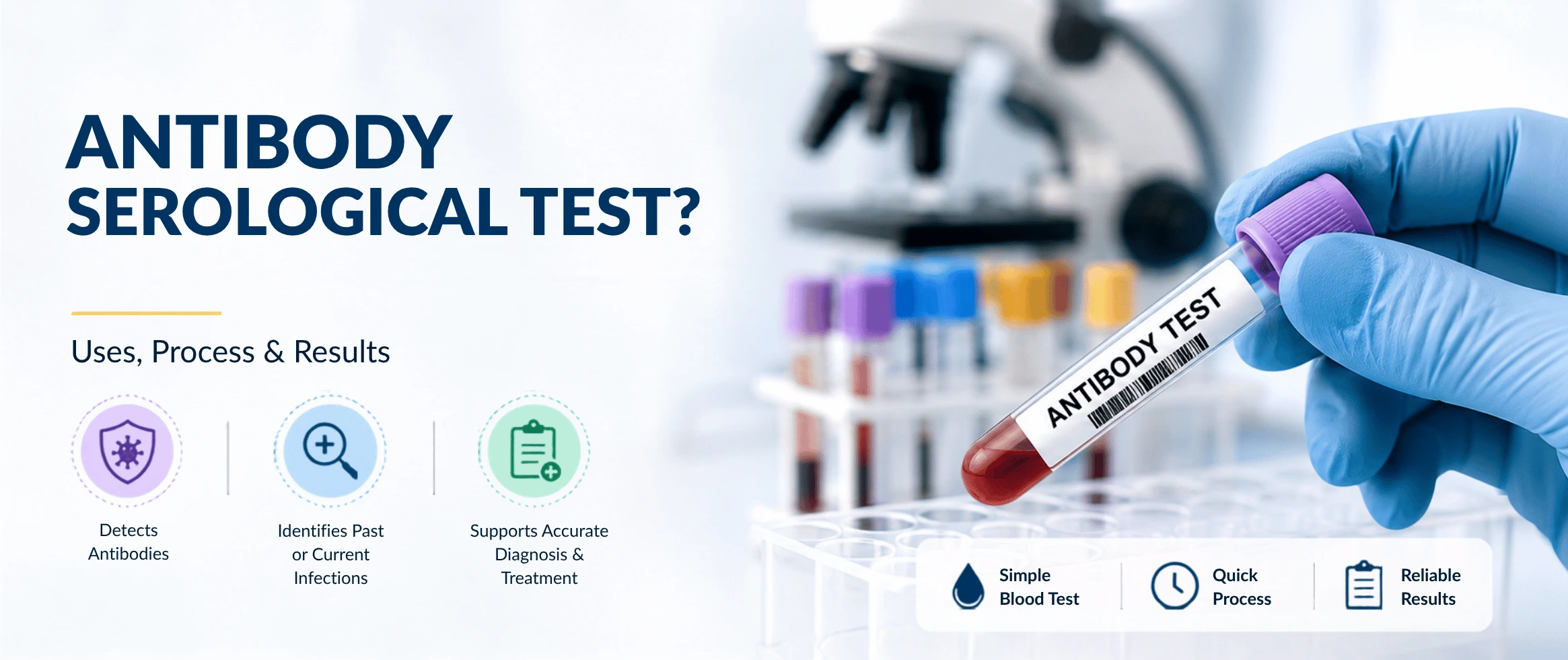
Have you ever had a fever that would not settle, a doctor asking about past infection, or a form that needs proof of vaccination or immunity? In such cases, your doctor may suggest a serology test.
A serology test is a blood test that looks for antibodies. Antibodies are proteins made by your immune system when your body meets germs such as viruses or bacteria, or after vaccination. In simple words, this test helps your doctor understand whether your immune system has “seen” a particular infection or has made a response to it. Few references explains that antibody serology tests look for specific antibodies in the blood and may be used to check past infection, vaccination status, autoimmune disease signs, or treatment response.
Many people search “what is serology test” because the name sounds complex. But the idea is simple. Imagine your immune system like a security guard. When a germ enters the body, the guard learns to recognize it and creates a record. A serology test checks for that record in your blood.
This blog explains the uses, process, result meaning, serology test list, and serology test price in a simple and practical way.
A serology test, also called an antibody serological test, is a laboratory test that usually checks antibodies in a blood sample. These antibodies may be linked to infections, vaccination response, or autoimmune conditions. Few references describes a serological test as a test that measures antibodies in blood to understand how strongly the immune system has responded to a disease.
The test may be reported in different ways:
For example, if your report says antibodies are detected, it may mean your body has responded to an infection or vaccine. But this does not always mean you currently have that disease. Antibodies can remain in the body for weeks, months, or even years depending on the infection and antibody type. The CDC notes that antibody detection can indicate infection at an unknown time and does not always mean current or acute infection.
This is why serology test results should always be understood with symptoms, medical history, vaccination history, and other tests if needed.
During a serology test, a small blood sample is taken from a vein in your arm. The sample is sent to a lab, where it is checked for specific antibodies. Few references says the blood draw usually takes less than five minutes and generally needs no special preparation.
Most antibody serology tests are designed to identify antibodies such as:
IgM Antibodies
IgM is often the first antibody your body makes when it responds to a new infection. It may suggest recent or current exposure, depending on the disease and timing.
IgG Antibodies
IgG usually appears later and may stay longer. It can suggest past infection, previous exposure, or vaccine-related immune response.
IgA Antibodies
IgA is commonly found in areas such as the respiratory and digestive tract. Some tests check IgA for specific conditions, such as celiac disease or certain infections.
The exact antibody tested depends on your symptoms and the condition your doctor is checking.
A serology test may be advised for many reasons. It is not a “one-size-fits-all” test. It depends on what your doctor is trying to find.
1. To Check Past or Recent Infection
Doctors may use a serology test to check whether your body has made antibodies against infections such as dengue, typhoid, hepatitis, HIV, rubella, measles, mumps, or chickenpox. Few references lists several infections that may be checked through serological testing, including measles, mumps, rubella, hepatitis, HIV, Lyme disease, and syphilis.
2. To Support Diagnosis When Symptoms Are Confusing
Fever, weakness, body pain, rashes, swollen glands, or long-lasting tiredness can have many causes. A serology test may help narrow down the cause when combined with clinical examination and other tests.
For example, in India, during monsoon or fever season, doctors may suggest dengue IgM/IgG, Widal, viral markers, or other antibody-based tests depending on symptoms and exposure risk.
3. To Check Vaccination Status
Some workplaces, schools, travel requirements, or medical situations may require proof of immunity. If old vaccination records are missing, a doctor may advise antibody testing for selected diseases. Few references states that antibody serology tests may help check vaccination status or determine whether a booster may be needed for a specific disease.
4. To Detect Autoimmune Conditions
In autoimmune diseases, the immune system may mistakenly attack the body’s own cells. Some serology tests look for autoantibodies. These may support the diagnosis of conditions like lupus, rheumatoid arthritis, antiphospholipid syndrome, or vasculitis. Few references also notes that serological tests can help diagnose several autoimmune diseases.
5. To Monitor Certain Treatments
Some antibody tests may be used during treatment follow-up, especially in autoimmune, inflammatory, transplant-related, or immune-related conditions. The meaning depends on the exact test and patient history.
Here is a simple serology test list to help readers understand common examples. Your doctor will choose the right test based on symptoms, risk, and history.
Infection-Related Serology Tests
Autoimmune Serology Tests
Immunoglobulin Tests
We have a dedicated Serology Automated ELISA and IFA Department, with trained technical staff performing more than 300 serological tests per day using latest technologies for timely reports.
If you are nervous about blood tests, you are not alone. Many people feel uneasy when they see a needle. The good part is that a serology test is usually quick and simple.
Before the Test
Most antibody serology tests do not need fasting. However, follow your doctor’s or lab’s instructions because some related tests may have special requirements. You should also tell your doctor if you take blood thinners, have a bleeding disorder, or feel faint during blood collection.
During the Test
A trained phlebotomist usually follows these steps:
Few references notes that a serology test is generally safe, though minor dizziness, soreness, bruising, or rarely infection may happen after blood collection.
After the Test
You can usually return to normal activities. If you feel lightheaded, sit for a few minutes and drink water. Keep the cotton or bandage on for some time if advised.
Serology test results can feel confusing. A positive result may not always mean active disease, and a negative result may not always rule it out. This is where timing matters.
Positive Result
A positive result means antibodies were detected. This may suggest:
For example, the FDA explains that a positive COVID-19 antibody test may mean previous infection or antibodies after vaccination, but it should not be used to diagnose active COVID-19.
Negative Result
A negative result means antibodies were not detected. This may suggest:
The FDA also notes that it can take days to weeks after infection for the body to make detectable antibodies, and antibody levels may reduce over time.
Borderline or Indeterminate Result
Sometimes, results are not clearly positive or negative. Your doctor may suggest repeating the test after a few days or using another test method.
Titer Result
A titer tells the antibody level. A higher titer may suggest stronger antibody presence, but the meaning depends on the disease. Do not compare titers across different labs or tests unless your doctor says it is valid.
Sometimes yes, but often not alone.
This is one of the most important points. A serology test checks the immune response, not always the germ itself. So, for many diseases, it may not be the best test for early or active infection.
For COVID-19, the FDA clearly states that antibody tests should not be used to diagnose active infection because they do not detect the virus itself.
For some infections, doctors may combine serology with:
Think of serology as one piece of the puzzle. It can be very helpful, but it should be read in the full health picture.
The serology test price depends on the exact antibody being tested, the method used, city, lab, and whether home sample collection is chosen. There is no single price for all serology tests because “serology” is a category, not one fixed test.
For example, We have different prices for different serology-related tests. WIDAL (Tube) is listed at ₹350, Dengue Duo Rapid Test at ₹1500, and HIV 1&2 Antibodies at ₹600 on their respective test pages.
Some advanced antibody or autoimmune tests may cost more because they need specialized methods such as ELISA, CMIA, IFA, or immunoassay-based testing.
Before booking, check the exact test name, sample type, preparation, report time, and price.
You should take a serology test only when advised by a doctor or when it is needed for a valid reason, such as vaccination documentation or screening.
A doctor may suggest it if you have:
Do not self-diagnose based only on antibody results. For example, a positive antibody result may create anxiety, but it may only show past exposure. On the other hand, a negative result may falsely reassure you if the test was done too early.
A serology test can be useful because it:
Like every medical test, serology has limitations.
It May Not Detect Early Infection
Your body needs time to make antibodies. Testing too early may give a negative result even if infection is present.
It May Not Prove Active Disease
Antibodies can stay after recovery. So, a positive result may not always mean you are currently sick.
False Results Are Possible
False positives and false negatives can occur. The FDA explains that sensitivity, specificity, timing, and prevalence affect antibody test accuracy and predictive value.
Results Need Doctor Interpretation
Two people may have the same result but need different next steps based on symptoms, age, risk, vaccination history, and medical background.
For most serology tests:
If multiple tests are booked together, preparation may change. For example, fasting may be needed for sugar or lipid profile tests but not for a basic antibody serology test.
Serology testing depends on correct sample handling, validated methods, trained staff, and accurate reporting. A good lab does not just collect blood. It follows quality processes from sample collection to result delivery.
We offer a wide range of diagnostic tests, including serology-related tests such as WIDAL, Dengue Duo Rapid Test, HIV 1&2 Antibodies, Viral Markers, Immunoglobulin tests, and autoimmune antibody tests. Our serology department uses technologies such as ELISA and IFA and performs a high volume of serological tests daily.
If your doctor has advised a serology test, choose the exact test name carefully and book it through a trusted diagnostic provider.
A serology test is a useful blood test that checks antibodies made by your immune system. It can help doctors understand past infection, recent exposure, vaccine response, autoimmune activity, or immune status. But it should not be read in isolation.
The most important thing to remember is this: a serology test result is not just “positive” or “negative.” Its meaning depends on timing, symptoms, vaccination history, medical history, and the exact antibody tested.
If your doctor has recommended a serology test, choose a reliable diagnostic lab, confirm the exact test name, check preparation instructions, and discuss the report with your healthcare provider.
Discover precision diagnostics with Pathkind Labs, a trusted name in diagnostic services in India. Our NABL accredited labs, equipped with advanced technology, are staffed by a certified team of over 200+ senior pathologists and 2000+ technicians. From tailored health check-ups to specialized tests in Oncology, Neurology, Gynaecology, Nephrology, and more, we've got your health covered. Skip the hassle with online booking for tests or check-ups, available for both lab visits and at-home blood collection. For a seamless experience and early detection, choose Pathkind Labs in Gurugram. Book your appointment today and experience diagnostics made easy.
© 2026 Pathkind Diagnostics Pvt. Ltd. All Rights Reserved | Unsubscribe











 Track Sample
 Upload Prescription