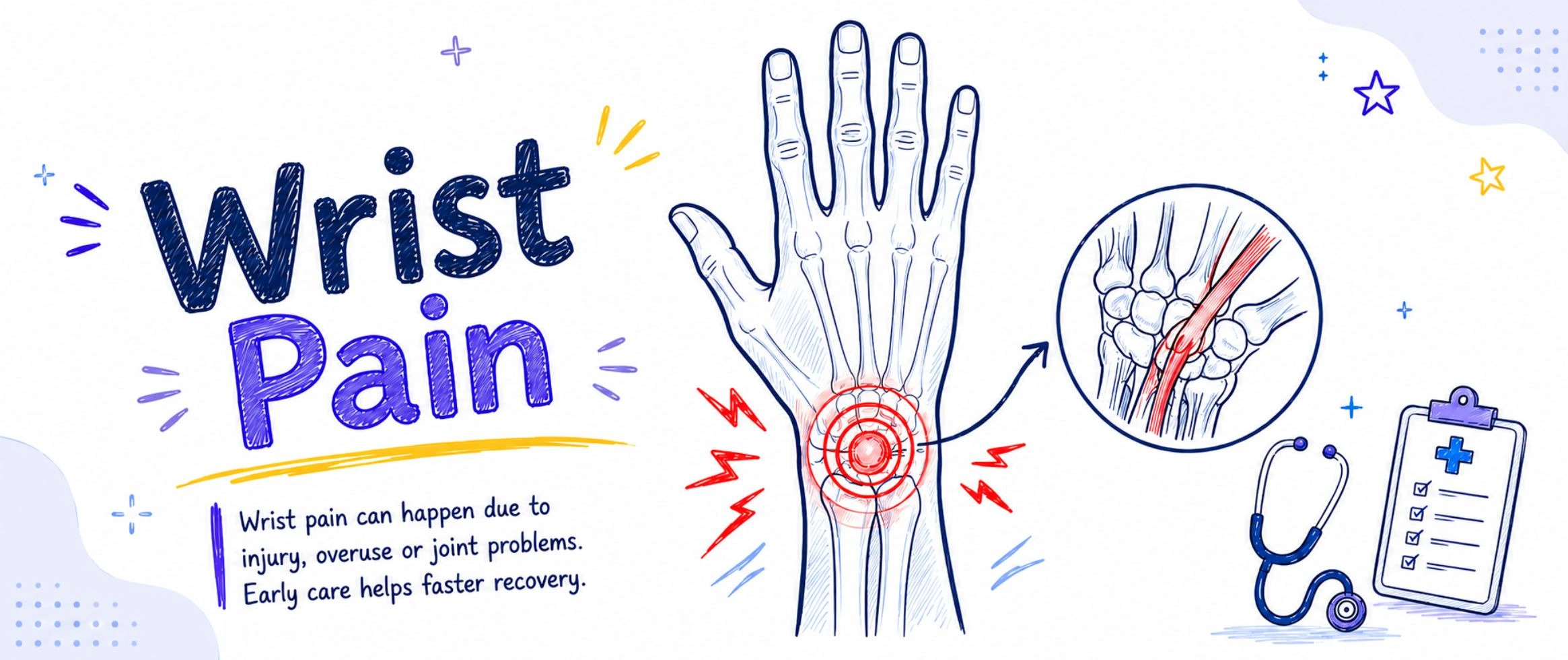
Wrist pain refers to discomfort in or around the wrist joint. It may feel like a dull ache, sharp pain, burning, stiffness or soreness. Some people notice pain only when moving the wrist, while others may experience discomfort even when resting.
The wrist is made up of small bones, ligaments, tendons, muscles and nerves. Because it helps us type, write, lift, grip and rotate objects, it is vulnerable to injuries and overuse.
For example, long hours on a laptop, repeated mobile phone use, lifting heavy shopping bags, playing cricket or gym exercises can all place stress on the wrist. A fall onto an outstretched hand can also cause a sprain or fracture.
The correct treatment depends on the cause. Wrist pain after an injury should not be treated in the same way as wrist pain caused by arthritis or nerve compression.
There are several possible wrist pain causes. Some are mild and improve with rest, while others require medical attention.
1. Wrist Sprain or Strain
A sprain happens when a ligament is stretched or torn. A strain affects a muscle or tendon. These injuries may occur after a fall, sudden twist, sports injury or lifting something heavy.
Common symptoms include:
Mild sprains may improve with rest and support. Moderate or severe injuries may need a wrist splint, physiotherapy or further tests.
2. Wrist Fracture
A fracture is a break in one of the wrist bones. It can occur after a fall, road accident, sports injury or direct blow. The distal radius, one of the forearm bones, is commonly involved in wrist fractures.
A fracture may cause severe pain, swelling, bruising, deformity or an inability to move the wrist. However, some small fractures may initially look like a sprain. This is why persistent pain after a fall should be assessed by a doctor.
An X-ray is commonly used to check for a broken bone. Treatment may include a splint, cast or surgery, depending on the type and position of the fracture.
3. Tendinitis and Repetitive Strain
Tendons connect muscles to bones. Repeated movements can irritate these tissues and cause tendinitis. Typing, writing, sewing, painting, using vibrating tools and repeated sports movements may trigger this problem.
The pain often develops gradually and may become worse when you move the wrist, grip an object or perform the activity that caused it. Rest, activity changes, physiotherapy and doctor-approved medicines may help.
4. Carpal Tunnel Syndrome
Carpal tunnel syndrome occurs when the median nerve is compressed at the wrist. It can cause wrist pain along with numbness, tingling or burning in the thumb, index finger, middle finger and part of the ring finger.
Some people notice symptoms at night or while holding a phone, driving or typing. Weakness may make it difficult to hold a cup, button clothes or open a jar.
Early treatment may include changes to work habits, a night wrist splint, exercises recommended by a healthcare professional and medicines. In some cases, steroid injections or surgery may be advised. Untreated nerve compression can sometimes lead to ongoing numbness and hand weakness.
5. De Quervain’s Tenosynovitis
De Quervain’s tenosynovitis affects the tendons on the thumb side of the wrist. It may occur after repetitive thumb use, lifting a child, gardening, texting or activities that involve gripping and twisting.
Pain is usually felt near the base of the thumb and may spread into the forearm. It can worsen when making a fist, lifting an object or moving the thumb.
Treatment may include activity modification, a thumb-supporting splint, cold packs, medicines, physiotherapy or a corticosteroid injection. The AAOS guide to De Quervain’s tenosynovitis provides further information.
6. Arthritis
Arthritis can cause wrist pain, swelling and stiffness. Osteoarthritis may develop due to ageing, previous injury or long-term joint stress. Rheumatoid arthritis can affect both wrists and may also cause pain or stiffness in other joints.
Wrist arthritis is often worse after periods of inactivity or during activities that require gripping. Treatment may include exercises, medicines, splints, injections or surgery, depending on the severity.
7. Ganglion Cyst
A ganglion cyst is a fluid-filled lump that may appear on the back or front of the wrist. It is usually non-cancerous. Some cysts are painless, while others may cause aching, pressure or discomfort during movement.
A doctor may diagnose a ganglion cyst during an examination. Ultrasound or other imaging may be used if the diagnosis is uncertain. Treatment is not always needed, but painful or persistent cysts may require drainage or removal.
8. Gout or Other Inflammatory Conditions
Gout occurs when uric acid crystals build up in a joint. It can cause sudden, intense pain, redness, warmth and swelling. Although gout commonly affects the big toe, it can also affect the wrist.
Other inflammatory conditions, including rheumatoid arthritis and certain infections, can also cause wrist pain. A hot, red and swollen wrist with fever needs urgent medical attention.
9. Cartilage or Ligament Injuries
The wrist contains cartilage and strong ligaments that help stabilise the joint. A twisting injury can damage these structures and cause pain, clicking, weakness or a feeling that the wrist is unstable.
These injuries may require an examination and imaging such as an MRI, especially when pain continues despite rest.
The symptoms depend on the underlying problem. You may experience:
The location of pain can also offer clues. Pain on the thumb side may occur with De Quervain’s tenosynovitis, while numbness in the thumb and first two fingers may suggest carpal tunnel syndrome. However, symptoms can overlap, so self-diagnosis is not reliable.
Seek urgent medical help if:
You should also arrange a medical consultation if the pain is getting worse, keeps returning, interferes with daily activities or has not improved after about two weeks of home care. When wrist pain persists, affects normal activities or is associated with tingling, loss of sensation, warmth, swelling or fever.
If you suspect a fracture, do not perform wrist pain exercises or force the joint to move before it has been assessed.
A doctor will usually begin by asking:
The doctor may then check your wrist’s strength, movement, swelling, tenderness and sensation.
Tests for Wrist Pain
Depending on your symptoms, the following tests may be recommended:
Treatment depends on the cause, severity and duration of the pain.
Home Care for Mild Wrist Pain
For mild pain without a serious injury, you may try:
Do not apply ice directly to the skin. Avoid using heat during the first two to three days after a new injury because it may increase swelling.
Medicines
A doctor or pharmacist may recommend paracetamol or a topical anti-inflammatory gel. Oral anti-inflammatory medicines such as ibuprofen are not suitable for everyone. People with kidney disease, stomach ulcers, certain heart conditions, pregnancy or blood-thinning medicines should ask a healthcare professional before taking them.
Do not take pain medicines for a long period without medical advice.
Physiotherapy
Physiotherapy can help restore movement, strength and coordination. A physiotherapist may use stretching, strengthening, joint mobilisation, posture correction and activity advice.
Injections or Surgery
Some conditions may require a corticosteroid injection. Surgery may be considered for a displaced fracture, severe nerve compression, persistent tendon problems, ligament damage or pain that does not improve with other treatment.
Wrist pain exercises may help with mild stiffness, recovery after treatment or gradual strengthening. They should be performed gently and should not cause sharp pain.
1. Wrist Flexion and Extension
Rest your forearm on a table with your hand over the edge. Slowly lower your hand and then raise it. Repeat 5 to 10 times.
2. Wrist Rotations
Keep your elbow close to your body and bend it at a right angle. Slowly rotate your palm to face upwards and then downwards. Repeat 5 to 10 times.
3. Gentle Tendon Glides
Start with your fingers straight. Slowly make a hook fist, then a full fist, and return to the starting position. Move slowly and stop if pain or swelling increases.
4. Soft Ball Grip
Using a soft foam ball, gently squeeze for three to five seconds and release. Repeat 5 to 10 times if there is no acute injury or swelling.
Do not perform strengthening exercises after a recent fall, suspected fracture, severe swelling or surgery unless your doctor or physiotherapist approves them. Exercises for carpal tunnel syndrome should also be selected carefully because the wrong movement may irritate the nerve.
You can reduce your risk by:
If your work involves typing, keep the keyboard at a comfortable height and avoid resting your body weight directly on the wrist.
The ICD-10-CM code commonly used for pain in the right wrist is M25.531. The corresponding codes are:
These are symptom codes. If a doctor confirms a fracture, sprain, carpal tunnel syndrome or arthritis, a more specific diagnosis code may be used. ICD-10-CM coding can vary by country, healthcare system and the confirmed diagnosis.
Wrist pain can result from a simple overuse problem, but it may also be linked to a fracture, tendon injury, nerve compression, arthritis or inflammation. Paying attention to the timing, location and associated symptoms can help guide the next step.
Rest and gentle care may help mild pain. However, severe pain, numbness, deformity, fever or pain after an injury should not be ignored. Early diagnosis can support faster recovery and reduce the risk of long-term stiffness, weakness or nerve damage.
Medical disclaimer: This article is for general information only and does not replace examination or treatment from a qualified healthcare professional.
Discover precision diagnostics with Pathkind Labs, a trusted name in diagnostic services in India. Our NABL accredited labs, equipped with advanced technology, are staffed by a certified team of over 200+ senior pathologists and 2000+ technicians. From tailored health check-ups to specialized tests in Oncology, Neurology, Gynaecology, Nephrology, and more, we've got your health covered. Skip the hassle with online booking for tests or check-ups, available for both lab visits and at-home blood collection. For a seamless experience and early detection, choose Pathkind Labs in Gurugram. Book your appointment today and experience diagnostics made easy.
© 2026 Pathkind Diagnostics Pvt. Ltd. All Rights Reserved | Unsubscribe











 Track Sample
 Upload Prescription